
-

ส่งอีเมลถึงเรา
sale@lscmagnetics.com -

เบอร์ติดต่อ
+86 -13559234186
ส่งอีเมลถึงเรา
sale@lscmagnetics.comเบอร์ติดต่อ
+86 -13559234186

Manual Tying vs. Machine Tying: An In-Depth Comparison and Selection Guide for Rebar Tying Methods
Jul 28, 2026In reinforced concrete construction, rebar tying is a critical process for ensuring structural safety. With the rise of industrialized construction, traditional manual tying is now facing strong competition from electric rebar tying machines. Faced with these two options, how should project managers and construction teams decide? This article offers an in-depth analysis from the perspectives of efficiency, cost, quality, and safety to help you make the best choice.
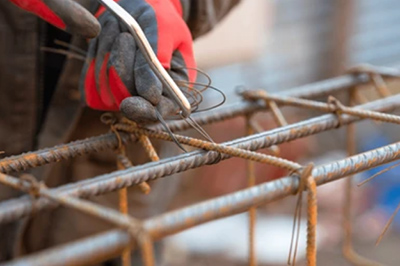
Manual tying depends heavily on the skill and stamina of the worker. A skilled rebar worker using a tying hook can complete roughly 20–30 knots per minute, with a daily output of about 8,000–10,000 knots. However, this is an extremely repetitive and wrist-intensive task; speed drops significantly with fatigue, and efficiency typically falls by more than 20% after lunch breaks.
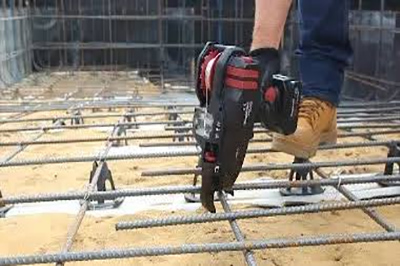
Machine tying, by contrast, completely changes the picture. Taking the currently popular portable electric rebar tying machine as an example, each tie takes only 0.8–1.2 seconds, enabling 50–75 knots per minute and a daily output of 25,000–30,000 knots. In other words, a single machine is 3 to 5 times more efficient than a skilled worker. On large foundation slabs, bridge decks, and other areas with dense rebar, this speed advantage translates directly into a substantial reduction in construction time.
Key insight: In large‑area, standard‑grid tying, three machines operated with two assistants can match or even exceed the output of a team of 8–10 experienced workers using hand tools alone.
Manual tying requires a large workforce. Given current market conditions, rebar workers command high daily wages, and skilled labor is becoming increasingly scarce. Machine‑assisted tying can reduce manual labor by 60%–70%, with one operator replacing 3–5 traditional tiers, leading to immediate savings in labor costs.
2. Material Costs
This is a cost gap that many overlook. Manual tying relies on the worker’s “feel” and experience, typically consuming 25–35 cm of wire per knot, and is prone to over‑stretching or leaving excess wire. Machines, with their precise wire‑feeding mechanisms, require only 15–20 cm per knot, saving 40%–50% of wire overall. On large projects, 10,000 knots can save over 1,000 meters of wire, yielding significant material savings over time.
A reliable portable rebar tying machine costs anywhere from several thousand to tens of thousands of yuan, and requires dedicated wire reels and batteries. For small or short‑term projects, this initial outlay may be hard to recoup. However, for projects with a construction period exceeding three months and involving tens of thousands of rebar joints, the equipment investment can typically be recovered within 1–2 months.
The quality of manual rebar tying is highly dependent on the worker’s skill level and daily condition. Even within the same shift, tying tightness can vary significantly from one worker to another; under fatigue, problems such as missed ties, loose knots, and insufficient binding occur frequently. These issues can lead to rebar displacement during concrete pouring and vibration, affecting protective layer thickness and structural stress distribution.
Machine tying, on the other hand, delivers industrial‑grade consistency. With every trigger pull, the machine outputs a fixed wire length, number of wraps, and tightening torque, resulting in uniform joint quality and a success rate of over 99%. This is especially critical for demanding applications such as prestressed components, bridge engineering, and seismic‑resistant structures.
Moreover, the protruding height of machine‑tied knots is typically less than 10 mm, well below the standard concrete cover thickness (generally 25 mm). This avoids the common manual‑tying problem where overly tall knots puncture the formwork or compromise the protective layer.
Rebar tying is widely recognised as a high‑intensity, highly repetitive task in the construction industry. Workers must maintain squatting or stooping postures for extended periods, repeatedly twisting their wrists, which easily leads to occupational disorders such as carpal tunnel syndrome and lumbar muscle strain. Statistics show that workers engaged in long‑term manual tying have a significantly higher incidence of musculoskeletal injuries than those in other trades.
Machine tying employs a one‑handed, standing or semi‑squatting operation, greatly reducing wrist twisting and lower‑back strain. Workers simply need to align the machine with the rebar intersection and pull the trigger, cutting physical exertion by over 80%. This not only improves the working environment but also reduces safety risks caused by fatigue and helps lower staff turnover.
| Project Type | Reasons |
| Large‑area floor slabs / base slabs | Regular rebar mesh with a large number of nodes, maximising machine efficiency. |
| Precast component factories | High repetition and strict quality requirements; machine standardisation shines. |
| Bridges, tunnels, subways | Tight schedules and high rebar density require rapid completion of tying. |
| Standard floors in high‑rise buildings | Repetitive work across floors, ensuring high equipment utilisation. |
| Project Type | Reasons |
| Small miscellaneous projects | Limited rebar volume makes equipment investment uneconomical. |
| Complex nodes / irregular components | Intricate rebar intersections make machine alignment and operation difficult. |
| Narrow spaces | Machine dimensions are restrictive at beam‑column joints and concealed columns in walls. |
| Emergency repairs and reinforcement work | Work surfaces are irregular; manual tools offer greater flexibility. |
| Remote sites without power supply | Machines depend on batteries or mains power; manual tools are more reliable. |
Manual tools (tying hooks, wire cutters) have a simple construction and require virtually no maintenance. A high‑quality tying hook can last for years with an extremely low failure rate.
Machines, however, require regular upkeep:
Daily: Clean the wire feed channel and check battery level.
Weekly: Inspect sensors and transmission gears.
Monthly: Lubricate key components and replace worn blades.
Common faults: Wire jams, poor feeding, battery degradation.
Although modern machines incorporate electromagnetic braking and wear‑resistant designs that have significantly improved reliability (some brands claim 1 million consecutive trouble‑free cycles), harsh site conditions—dust, rain, and accidental drops—can still cause breakdowns and downtime. It is therefore advisable to keep a backup machine and spare parts on site.
Manual tying and machine tying are not mutually exclusive but complementary. Wise construction managers should adopt a hybrid approach based on project characteristics:
Selection Decision Tree
1. Total number of rebar joints > 50,000?
├── Yes → Prioritise machine tying (significant efficiency and material savings)
└── No → Assess construction period and labour costs; consider manual or limited machine use.
2. Is the rebar mesh regular and is there sufficient working space?
├── Yes → Machine tying as the primary method.└── No → Manual tying as the primary method, with machine assistance where possible.
3. Is the construction period tight (e.g., bridge or subway node projects)?
├── Yes → Machine tying should be introduced.
└── No → Flexible choice is acceptable.
4. Does the budget allow for equipment investment?
├── Yes → Machines offer higher long‑term ROI.
└── No → Stick with manual tying, but accept higher labour costs.
Large‑scale infrastructure, commercial complexes, prefabrication plants: Use machine tying as the primary method, with a small team using manual tools for corners and complex details.
Residential projects, small foundations, repair and reinforcement: Use manual tying as the primary method, and consider renting machines depending on the volume of rebar.
Hybrid strategy: Deploy machines to accelerate standard areas, while retaining manual precision for complex details—achieving the optimal balance between efficiency and quality.
The choice of rebar tying method ultimately comes down to a trade‑off between efficiency, cost, and quality. With labour costs continuing to rise and construction deadlines becoming ever tighter, machine tying is shifting from a “nice‑to‑have” tool to a “must‑have” competitive differentiator. Nevertheless, manual tying—with its flexibility and low barrier to entry—will remain a fixture on construction sites for the foreseeable future. Understanding the strengths and limitations of each approach and allocating resources appropriately is a core competency of modern construction management.
Whatsapp : +86 -13559234186
อีเมล : sale@lscmagnetics.com
โทร : +86 -13559234186